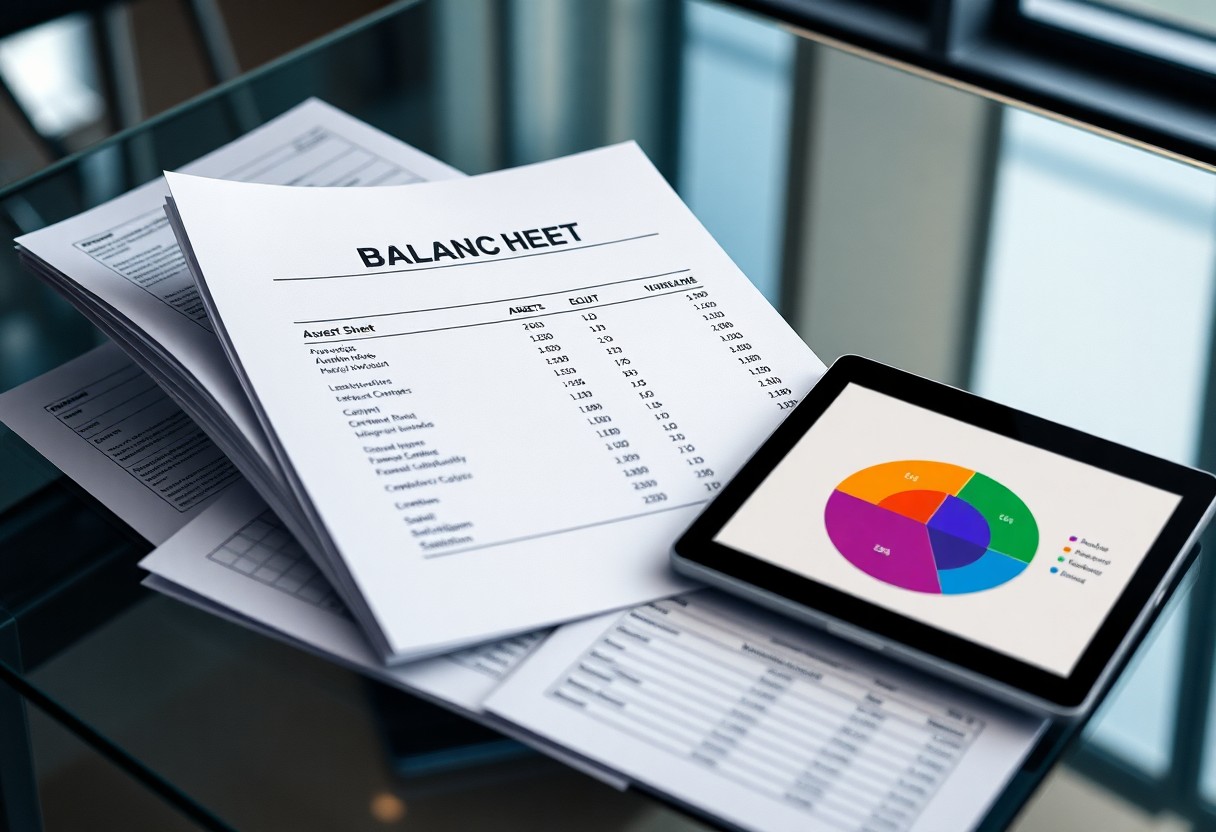
Most business owners understand that effective financial management is key to success, yet many struggle with the concept of balance sheets. This imperative financial statement provides a snapshot of your company's assets, liabilities, and equity at a specific point in time, enabling you to assess its financial health. By exploring examples of balance sheets, you can gain clarity on their structure and learn how to interpret them for better decision-making in your financial strategies.
Key Takeaways:
- Balance sheets provide a snapshot of a company's financial position, detailing assets, liabilities, and equity.
- Understanding the accounting equation (Assets = Liabilities + Equity) is fundamental to analyzing balance sheets.
- Examples of common line items include cash, inventory, accounts payable, and retained earnings, which illustrate different financial management aspects.
The Anatomy of a Balance Sheet
A balance sheet consists of three primary components that offer insights into a company's financial stability: assets, liabilities, and equity. This financial document reflects your business's worth at a specific point in time, allowing for a quick assessment of current financial standing. By analyzing these components, you can make informed decisions regarding resource allocation, investment opportunities, and overall fiscal health.
Key Components: Assets, Liabilities, and Equity
Your balance sheet's assets include everything your business owns, such as cash, inventory, property, and equipment. Liabilities, on the other hand, represent your business's obligations, including loans, accounts payable, and other debts. The remaining component, equity, is the residual interest in your assets after deducting liabilities, imperatively reflecting your ownership stake. Understanding these components helps you evaluate your financial position effectively.
The Equation that Drives Financial Health
The fundamental equation of a balance sheet is Assets = Liabilities + Equity. This principle ensures that every financial transaction is accurately reflected in your accounts. If your assets are greater than your liabilities, you have positive equity, indicating a financially sound position. Conversely, if liabilities exceed assets, your business might face potential insolvency, necessitating immediate attention to address financial challenges.
This equation not only provides a framework for maintaining financial accuracy but also serves as a diagnostic tool for assessing your business health. For instance, if you find that your liabilities consistently increase while assets stagnate, it may indicate the need for restructuring. Regularly aligning your balance sheet with this equation allows you to track growth, make informed decisions, and secure funding when necessary, reinforcing the foundation for long-term success.
Real-World Applications: How Businesses Utilize Balance Sheets
Businesses rely heavily on balance sheets to gain insights into their financial health. You can assess liquidity, leverage, and the overall capital structure, which informs strategic decisions. For example, startups utilize balance sheets to secure funding by demonstrating financial stability and asset management. For a deeper understanding, refer to the 5 Things to Know About Your Balance Sheet.
Assessing Financial Stability Through Ratio Analysis
Ratio analysis provides valuable insights into your financial stability by evaluating relationships between various balance sheet items. Common metrics include the current ratio, which indicates liquidity, and the debt-to-equity ratio, showing leverage. By analyzing these ratios, you can gauge your company's capacity to meet short-term obligations and its financial structure, helping you identify potential areas for improvement.
Decision-Making Power: From Investors to Managers
The balance sheet serves as a vital tool for decision-making among investors and managers. Investors analyze the sheet to evaluate the risk and return of potential investments, while managers use it to allocate resources effectively and guide strategic planning. A solid understanding of your assets and liabilities allows for stronger cash flow management, impacting investment strategies and operational efficiency.
Additionally, savvy managers can leverage balance sheet data to assess operational efficiency and profitability. For instance, if you notice a decline in asset utilization ratios, it may signal a need to optimize inventory or streamline processes. Investing decisions, such as funding new projects or scaling operations, are supported by the insights derived from balance sheet evaluations. A proactive approach in analyzing these figures can provide a competitive edge, ensuring long-term financial success.
Common Missteps: Navigating Balance Sheet Pitfalls
Many businesses encounter common pitfalls when interpreting their balance sheets, leading to costly misjudgments in financial management. Misunderstanding the intricacies of assets and liabilities can skew your perception of financial health. For a deeper understanding, refer to the Basic understanding of a company's financial statements.
Misinterpretation of Assets and Liabilities
Miscalculating or misclassifying your assets and liabilities can present a flawed financial picture. For example, misvaluing inventory or excluding certain liabilities can distort your equity and lead to misguided investment decisions.
The Dangers of Omitted or Misclassified Items
Failing to include or improperly classifying items on your balance sheet can result in severe repercussions. Misclassification of short-term versus long-term liabilities might cause you to miscalculate liquidity ratios, impacting your ability to meet obligations effectively.
Omissions can significantly distort your balance sheet visibility. For instance, if you don’t record contingent liabilities, you may appear more solvent than you truly are, leading to misguided investment or financing decisions. Similarly, misclassifying capital leases as operating leases can hide potential financial strain and mislead stakeholders about your company’s leverage position. Accurate classification ensures stakeholders can make informed decisions based on a true representation of your financial standing.
Building a Strong Balance Sheet: Strategies for Success
Developing a robust balance sheet requires strategic planning and discipline. Focus on maintaining a healthy ratio of assets to liabilities, which reflects your financial health. Allocate resources wisely, invest in liquid assets, and minimize debt. For a comprehensive approach to building your balance sheet, explore How to do a balance sheet: Complete guide with examples.
Best Practices for Accurate Financial Reporting
Accuracy in financial reporting hinges on meticulous record-keeping and regular reconciliations. Consistently cross-check your records against bank statements and invoices to identify discrepancies early. Utilize accounting software to streamline this process and ensure data integrity, which ultimately enhances decision-making.
Tips for Continuous Monitoring and Adjustment
Regular reviews of your balance sheet can reveal trends and highlight areas for improvement. Schedule monthly assessments to analyze changes in asset values and liabilities. Utilize these insights to make informed adjustments to your financial strategy.
- Set a monthly review schedule for your balance sheet.
- Update inventory and asset valuations frequently.
- Track changes in liabilities to address potential issues.
- The more consistent your monitoring, the more proactive you can be.
Engaging in ongoing monitoring includes not just assessing numbers but identifying potential risks and opportunities within your financial framework. Set benchmarks for financial ratios and prioritize transparency in reporting. Staying updated with market conditions can also enable you to adjust your strategy to safeguard your financial health.
- Adjust your approach based on seasonal trends in your business.
- Engage with financial advisors to optimize practices.
- Incorporate feedback from stakeholders to refine strategies.
- The aim is to create a dynamic balance sheet reflecting your business’s evolving landscape.
The Forward-Thinking Balance Sheet: Trends and Innovations
Modern balance sheets are evolving beyond traditional frameworks to incorporate innovative approaches that enhance their utility in decision-making. From sustainability metrics to real-time data integration, organizations are redefining how they present financial information to stakeholders. By leveraging these trends, you can gain a more comprehensive view of your company's financial health while aligning with emerging market expectations.
Integrating Technology for Enhanced Accuracy
Using advanced software and analytics tools can significantly improve the accuracy of your balance sheet. Automated data entry reduces human error, while real-time tracking software allows you to update your financials as transactions occur. This integration ensures that the figures you present are always reflective of your current financial situation, enabling timely decision-making.
The Evolving Role of Financial Forecasting
Financial forecasting has become a dynamic component of effective balance sheet management, as it allows you to anticipate and prepare for future financial conditions. With sophisticated modeling techniques, you can project income, assess expense trends, and identify potential cash flow issues. Practical examples demonstrate how businesses have successfully pivoted their strategies based on accurate forecasts, driving sustainable growth and helping secure investor confidence.
Incorporating forward-looking projections into your balance sheet not only helps you anticipate funding needs but also clarifies how operational decisions will impact overall financial health. For instance, examining historical data alongside predictive analytics allows you to pinpoint seasonal fluctuations in revenue, enabling more informed budgeting. Additionally, utilizing scenario analysis can prepare you for various market conditions, fostering agility in strategy adjustments. By aligning your balance sheet with well-crafted forecasts, you establish a clearer roadmap for both short-term operations and long-term objectives.
Summing up
Presently, understanding balance sheets empowers you to manage your finances effectively. By analyzing assets, liabilities, and equity, you gain insight into your financial health. For instance, comparing current liabilities to current assets allows you to evaluate liquidity. Through practical examples, you can apply this knowledge to make informed decisions that strengthen your financial position. Mastering balance sheets is integral to achieving your financial goals and ensuring sustainable growth for your business.
FAQ
Q: What is a balance sheet?
A: A balance sheet is a financial statement that provides a snapshot of a company's assets, liabilities, and equity at a specific point in time, allowing for assessment of financial stability.
Q: What are the key components of a balance sheet?
A: The key components are assets (resources owned), liabilities (obligations owed), and equity (owners' residual interest in the assets after liabilities are deducted).
Q: How do you read a balance sheet?
A: To read a balance sheet, start with assets at the top, followed by liabilities, and finally equity. Ensure that the accounting equation (Assets = Liabilities + Equity) holds true.
Q: Can you provide an example of a balance sheet?
A: Yes, for example: - Assets: Cash: $10,000, Inventory: $15,000, Equipment: $25,000 (Total Assets: $50,000). - Liabilities: Accounts Payable: $10,000, Loans: $20,000 (Total Liabilities: $30,000). - Equity: Owner’s Capital: $20,000 (Total Equity: $20,000). This shows that $50,000 in assets is balanced by $30,000 in liabilities and $20,000 in equity.
Q: Why is a balance sheet important for financial management?
A: A balance sheet is important because it helps management assess financial health, make informed decisions regarding investments, and address liquidity and solvency issues for effective business strategies.


0 Comments